


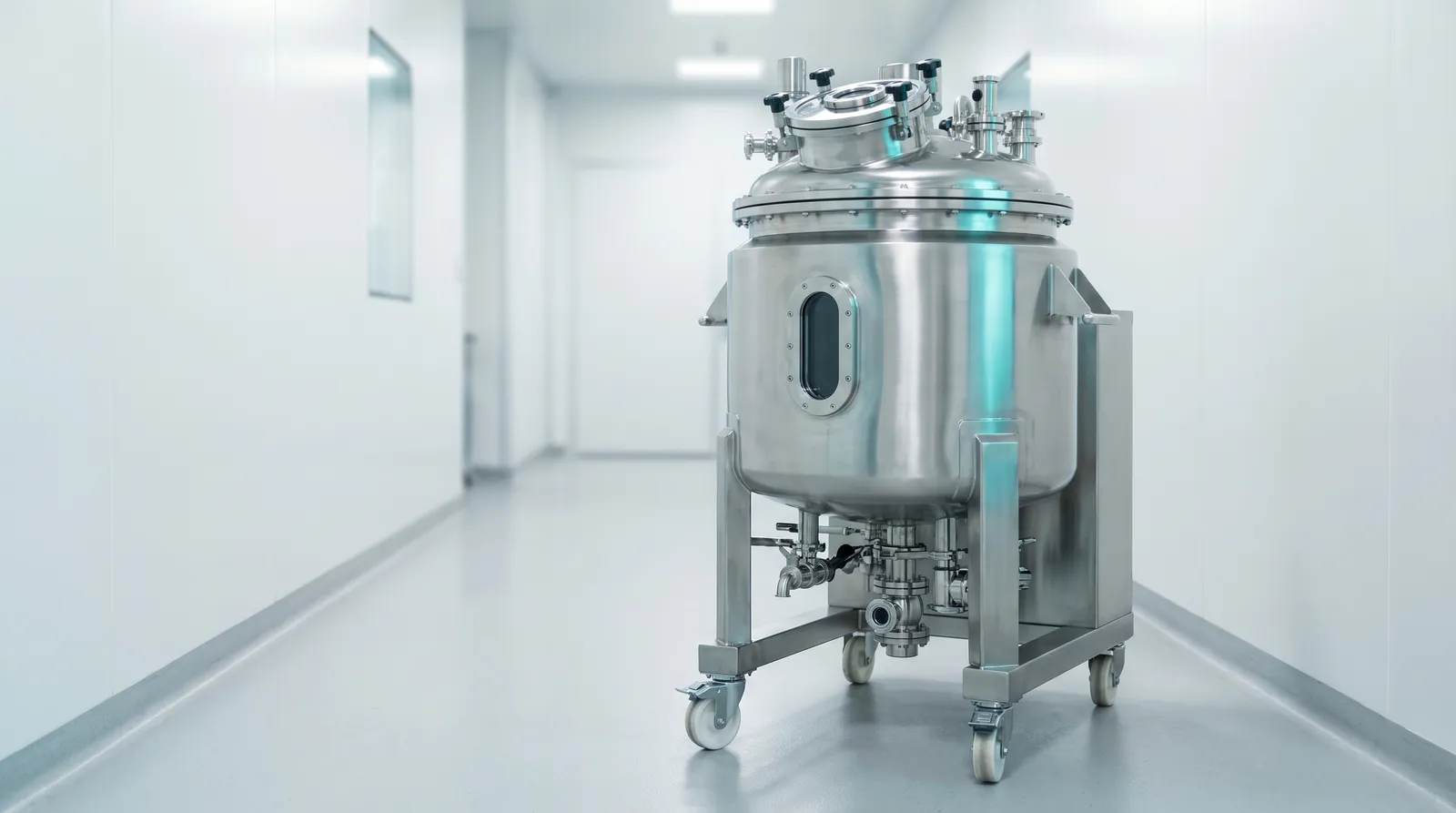
Mobile pharmaceutical containers remain digitally invisible, costing time, money, and compliance. How IIoT, NOA, and hygienic design close the data gap.
Imagine this: In your production facility, almost everything is digitally networked. Sensors deliver real-time data, control systems monitor processes around the clock, and your ERP system always knows exactly where each batch is located. Almost everything. Because out there in the cleanroom, a mobile batching container is rolling – and its contents are completely invisible to your systems.
From data hole to wheels
This scene precisely illustrates the blind spot of today's pharmaceutical production. While the industry has been working for years on smart, fully networked factories under the label Pharma 4.0—the ISPE Pharma 4.0 Operating Model being the authoritative framework for this—an entire group of process units remains outside this concept: mobile stainless steel containers. Mixing vessels, reactors, drug carriers, and intermediate containers roll on casters through cleanrooms, pass through washing booths, are moved and used—generating data that hardly anyone systematically records.
Stationary systems are digitally networked. Mobile containers produce goods – and then disappear into a data void.
The contradiction is obvious: A SCADA or MES integration is planned at great expense for a permanently installed stirred tank system. For the identical mobile mixing vessel on wheels right next to it, the same level of validation applies in extreme cases—but from an IT perspective, it simply doesn't exist. This is not an isolated case, but rather the norm in many pharmaceutical plants.
What actually happens in everyday life
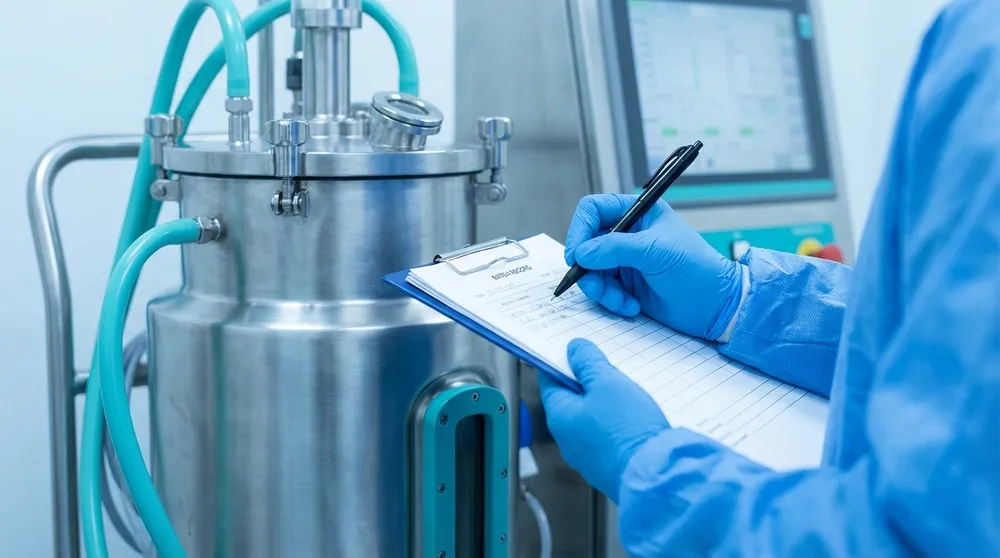
Anyone working in a GMP production facility today knows this gap from direct experience. Typical scenarios look like this:
A specialist reads the fill level, temperature or stirrer speed on the display of the container and records the values on a prepared paper protocol.
After the end of a shift or after completion of the batch, these values are transferred to the batch record or an ERP system — manually, with all the typical sources of error of double entry.
If a value deviates from the specification, the detective work begins: When was what measured, which container was in which position, who was responsible?
This gap often remains invisible in everyday life. Its economic impact, however, does not.
What data integrity according to Annex 11 actually requires
The regulatory framework makes it clear why the data gap is not merely a matter of convenience. EU GMP Annex 11 is the central document for computerized systems in pharmaceutical manufacturing and requires fully traceable, tamper-proof records of production data—regardless of where exactly this data originates.
In short — ALCOA+: Process data must be Attributable, Legible, Contemporaneous, Original, Accurate , and additionally Complete, Consistent, Enduring, and Available . These nine criteria apply equally to paper-based, electronic, and hybrid records .
Paper fulfills these requirements in principle—but only with considerable effort. The "contemporaneous" requirement is violated by definition when transferring handwritten values into the system. The "attributable" requirement necessitates additional signature processes for paper documents. And the "accurate" requirement is shifted to a second verification step with every transcription. What is covered by automated audit trails for stationary systems currently has to be painstakingly replicated for mobile containers.
What a batch really costs
An analysis from the trade publication CHEManager illustrates the cost of this in practice: In German pharmaceutical plants, process costs per batch are conservatively estimated at around €2,500 , with a single release taking between 40 and 500 hours depending on complexity. The biggest drivers are not the actual production, but rather testing, documentation, and reconciliation.
Where mobile containers come into play in this calculation:
Time delay — every manually recorded value extends the release process because additional review steps are required in quality assurance.
Double recording — the same values are documented twice (paper + system), checked twice and archived twice.
Sources of error — transposed numbers, reading difficulties, forgotten lines. Every error must be addressed, commented on, and, if necessary, managed as a deviation.
Error analysis — in the case of out-of-spec events, reconstruction from paper notes is time-consuming and less precise than from a digital audit trail.
Audits — inspectors strictly assess data integrity; rework based on findings can block a batch.
Even small optimizations to batch release can save considerable sums when dealing with tens to hundreds of thousands of releases per year.
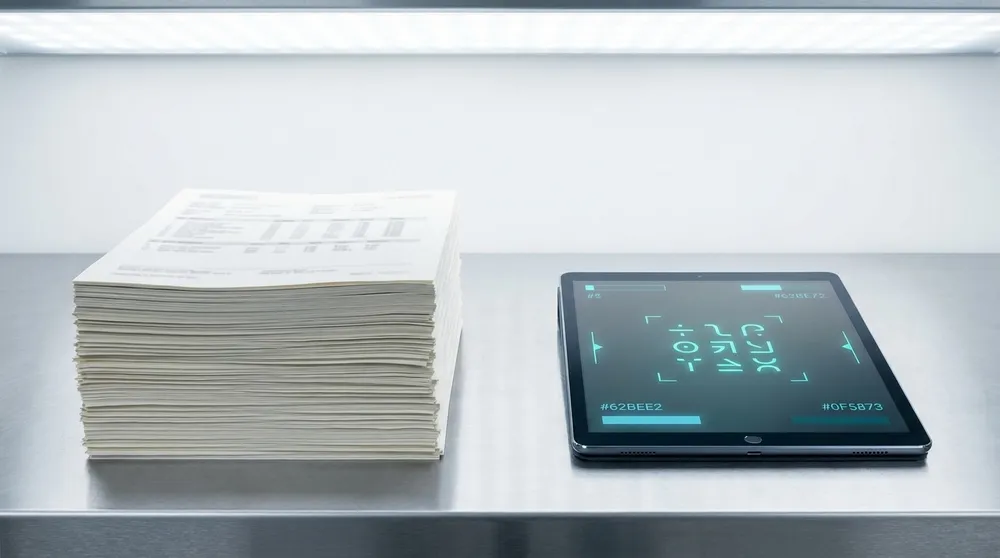
Why stationary systems always come first
Why do digitization projects almost never start with mobile containers? Because stationary systems are easier to integrate. Fixed cabling, defined interfaces, known locations – all of this can be planned and is therefore included in the specifications.
What makes mobile units more complicated? They are located in changing zones, require wireless communication, must remain CIP/SIP cleanable, and simultaneously be GMP-compliant and validatable. Three disciplines at once—and each of them can become a stumbling block in a project.
So why is the issue often postponed? Because daily priorities in a pharmaceutical plant rarely include the digitization of containers. Audits, product changes, qualifications, and new active ingredients regularly take precedence. Anyone who has worked in the industry for any length of time knows the result:
Later often becomes never.
Technical hurdles — and how to overcome them
The objections to digital mobile containers are justified — but none of them are insurmountable today:
Surface roughness: According to established practice, product-contacting surfaces require a surface roughness (Ra) of ≤ 0.8 µm , and significantly lower values are required in demanding pharmaceutical applications. Sensor modules can now be integrated into electropolished stainless steel housings with precisely this quality – without dead spaces or screws in contact with the product.
Cleanability:EHEDG guidelines for the hygienic design of tanks and pipelines apply analogously to attached components. CIP/SIP suitability is now considered during the design phase, not retrofitted.
Wireless communication: Traditional fieldbuses cannot be used on rolling stock. Industrial wireless technologies—from WLAN with WPA3 to 5G campus networks—solve this problem when integrated early into the network and IT security architecture.
Control system integration: The NAMUR Open Architecture (NOA) with its NE-175-ff recommendations describes a secure, OPC UA-based way to extract additional field data from the core automation — without affecting the process control technology.
Validability: The principles of the second edition of ISPE GAMP 5 offer a risk-based validation approach that explicitly considers mobile field data and cloud components.
Modular IIoT entry point: From pilot container to fleet
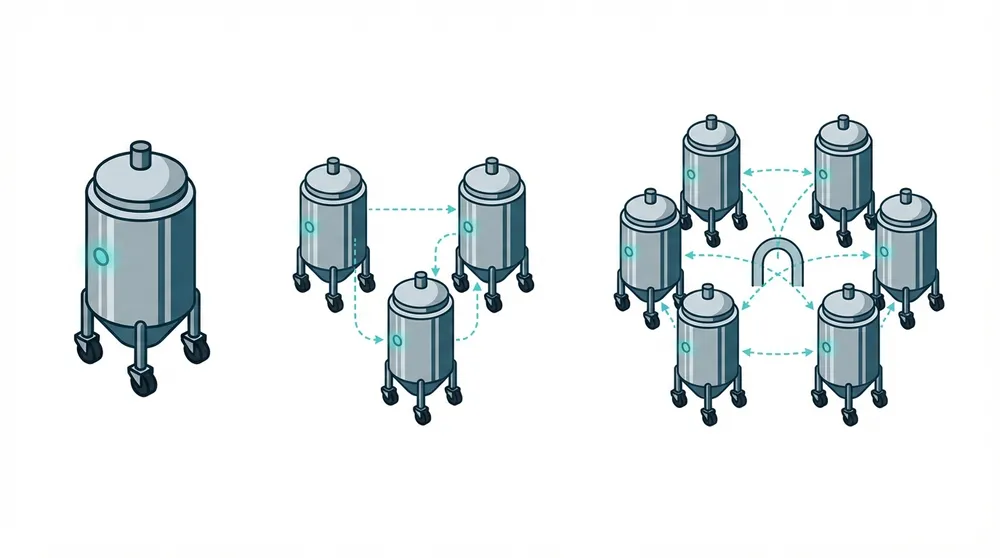
The pragmatic approach is not a factory-wide rollout, but a clearly defined pilot project. Whoever successfully digitally maps a single mobile container gains the reference architecture upon which the entire fleet will later be built. A typical approach:
Select a use case: A container with high release relevance and clearly measurable effect (e.g., batch containers in drug manufacturing). Define success metrics in advance—e.g., reduced review time per batch.
Integrate sensors: temperature, pressure, fill level, stirrer speed, position, cleaning status — hygienically installed, with suitable surface quality and EHEDG-compliant design.
Setting up a gateway: A peripheral device on the container collects the sensor data, buffers it in case of radio gaps, and transmits it securely to an IIoT platform or directly to the MES.
Validation according to GAMP 5: Risk-based, with a clear separation between supplier responsibility (device, software) and operator responsibility (configuration, operation).
Scaling: Connect additional containers following the same pattern. The reference architecture is in place — each additional unit is then a business decision.
Concrete reference projects demonstrate that this approach works in practice—for example, the IIoT architecture for mobile pharmaceutical containers described in pharmaindustrie-online . A more in-depth perspective on the topic of digital twins can be found in the article "Are mobile production facilities the future of the pharmaceutical industry?" .
Conclusion
Mobile pharmaceutical containers are the last blind spot in an otherwise increasingly digitized industry—and this blind spot measurably costs money, time, and regulatory compliance. The technology to close it has long been available: hygienically integrated sensors, industrial wireless technology, open interfaces according to NOA, and GAMP 5-based validation. Starting with a pilot container quickly yields reliable experience and a reference architecture upon which a complete mobile fleet can later be built. Crucially, it's important to recognize that investing in mobile digitization is not a secondary consideration, but directly impacts batch release, data integrity, and manufacturing costs. The blind spot begins with the container's wheels—but its economic impact extends far beyond that.